Real Estate Project and New-Build Apartment Marketing
A campaign cannot rescue a development that skipped the groundwork. We begin with market research and a map of competing inventory, build a clear offer without manufactured urgency, align the campaign with the sales team, and measure every shekel through to the deal. When a project has an English-speaking audience, we can also reach it through the platform we have already built.
- Search impressions
- 8.69M
- Clicks outside Israel
- 58%
- Attributed inquiries
- 350+
Project launch system
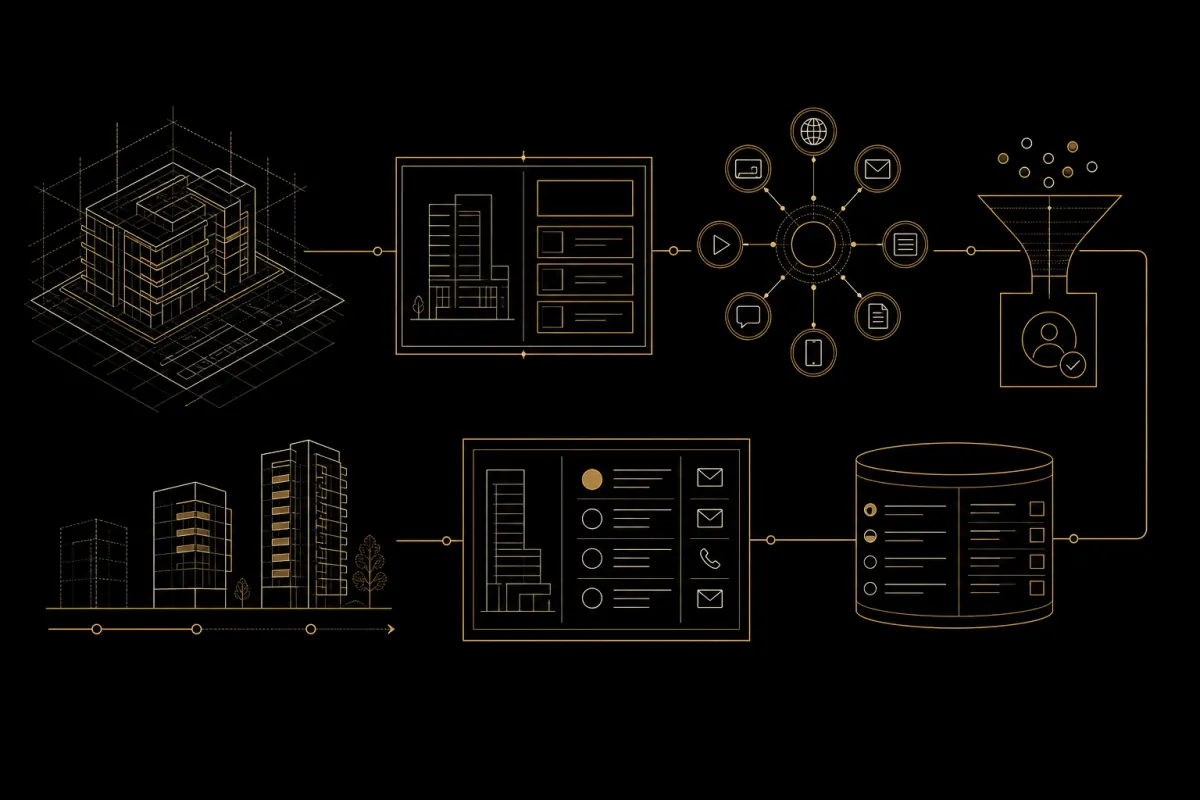
A launch system, not a collection of ads
Positioning, channel execution, lead qualification and sales follow-through must work as one operation. The visual makes those handoffs explicit.
- Positioning
- Channel plan
- Qualification
- Sales follow-through
Who this service is for, and who it is not for
This page covers the core of our real estate marketing operation for developers, contractors and property companies: marketing a residential development from the quiet work before launch through the sales tail. Much of the budget wasted in project marketing is lost before the first ad goes live, through generic positioning, an unresolved offer and missing measurement infrastructure.
Who it is for
Developers and contractors with a residential project at any stage: before launch, in presale, under construction with sales moving more slowly than planned, or down to final units that have stalled. Marketing leaders who want a partner reporting to the deal, not the click. It is also for projects with a natural audience among English speakers and foreign residents, even when nobody has addressed that audience yet.
Who it is not for
Anyone looking only for an external sales floor. We do not replace the sales team; we align with it. It is also not for anyone expecting a guaranteed sellout by a fixed date. We do not promise the outcome; we measure it. And if a development is priced well above its market without a defensible reason, a campaign will not repair an offer that does not work.
The project types we support include residential towers and new neighborhoods, boutique buildings, TAMA 38 and demolition-and-rebuild urban renewal, luxury developments, and projects with stalled inventory preparing for a relaunch.
The business problem: there is exposure, but no deals
Developers tend to describe the same frustrations. The campaign produces clicks, but the phone is quiet. Incoming inquiries cannot meet the budget or want a different city. Meetings are taking place, but reservations are not. Nobody can say which channel brought the buyers who did sign.
A trust problem sits above all of this. Israeli buyers have learned to be skeptical. Consumer guidance teaches them to identify a marketing presale and treat every countdown timer as a tactic. When every second project promises minutes from the sea and a rich specification, the messages stop registering.
That is why our answer does not start with media. It starts with the groundwork.
The groundwork before a campaign
Before setting a budget, message or channel, the team needs written answers to six questions. This stage is often skipped because it is not glamorous. It is also what separates a campaign aimed at a defined market from one built on guesses.
- Competing inventory: how many units are available within the relevant radius, in what mix and at what price per square meter, and how much new supply will enter the market during your sales period.
- Absorption rate: how many units comparable projects in the city sell each month, and what that implies for a realistic target for your development.
- Pricing: where the project sits against competing new construction and second-hand homes in the neighborhood, and exactly what justifies any premium.
- Audiences: who actually buys in this city, whether investors, families, move-up buyers or foreign residents, and in what proportions.
- Unit mix: whether the planned mix reflects real demand, or whether certain apartment types will sell last and define the sales tail.
- Differentiation: one message the project across the road cannot credibly claim. If none exists, that is the first problem to solve.
This initial analysis is exactly what we offer at the bottom of the page. Even if you do not work with us, do not launch a campaign without it.
What the marketing engagement includes
Positioning and a message for each audience
A feature is a fact about the building; a message is a reason to buy. Investors need to understand rental demand and potential return, families care about schools and community, and move-up buyers want a better home without leaving a familiar area. We cover the full brand work, including naming, visual language and signage, on a separate page.
Branding, content and public relations for developmentsOffer design
A launch price with a coherent step-up logic, a financing benefit or payment schedule suited to the audience, and clearly written terms: what the specification includes, what costs extra and when occupancy is planned. A sound offer filters out poor fit early.
Campaign and measurement infrastructure
Landing pages with qualification questions, call and form tracking, Google and Meta campaigns aligned to the project stage, and every inquiry written to CRM with complete source attribution.
A bridge to English-speaking buyers
When the city and segment fit, we can open a channel Hebrew marketing does not reach: the audience already reading our English platform in Israel and abroad, including foreign residents and people planning aliyah.
The project lifecycle: from pre-launch to relaunch
Project marketing is not one campaign. It is a sequence of stages, each with a different objective, audience and budget. Running the same campaign from launch to occupancy usually shows up in a slower sales pace.
| Stage | Objective | Where marketing matters most |
|---|---|---|
| Pre-launch | Build a waiting list before inventory is released | Research, positioning, early registration and a Friends & Family round |
| Presale | Sell a defined share of inventory early, including support for lender financing milestones | A genuine offer to a warm list and a managed sales event |
| Launch | Reach the peak of exposure and meetings | A broad campaign, public relations, the sales office and a model apartment |
| Construction | Maintain a steady sales pace over an extended period | Optimization using CRM data, remarketing and progress updates |
| Approaching occupancy | Convert buyers who wanted to see the development take shape | Site tours, progress content and confidence in the delivery timeline |
| Final apartments | Sell specific inventory rather than the project in general | Campaigns for defined units and tailored offers |
| Stalled inventory | Diagnose why units have not sold | A fresh analysis of price, mix and message |
| Relaunch | Return to market with a new story | Updated positioning, a revised offer and an audience not yet reached |
Our guide to marketing a new real estate project in Israel breaks these stages down in practical terms, including what must be ready before media goes live and the launch checklist your team should use.
An offer that sells without manufactured urgency
Our starting assumption is that the buyer is intelligent. One published industry explainer describes a genuine presale as a limited release, typically around 15%-20% of inventory, offered at a meaningful discount and generally without broad advertising. When the entire project is put into presale behind a countdown timer, buyers recognize the tactic, and trust in the development suffers.
Our offer design therefore stands on four elements. First, a launch price with clear steps and an increase logic the team can explain aloud. Second, a financing benefit or payment schedule suited to the audience, such as a 20/80 structure where relevant. Third, complete clarity on the specification, upgrades, indexation and expected occupancy. Fourth, no artificial urgency. Genuine urgency comes from genuine inventory. When a price tier changes because units have sold, the project can and should say so.
This is not only an ethical point; it is commercial. A transparent offer filters earlier, shortens negotiation, reduces losses on the path to contract and gives satisfied buyers a reason to recommend the next sales phase.
Aligning the campaign with the sales desk
The most common gap we encounter is not inside the campaign or the sales team, but at the handoff between them. The ad promises one thing, the script says another and the CRM records almost nothing. We treat that handoff as part of the service:
- Call scripts derived from campaign messages, so the buyer hears the same proposition on the phone that appeared in the ad.
- Consistent qualification questions: budget, city, transaction type, purchase timing, financing status and willingness to meet. These are the fields we also use in our own pipeline.
- Complete CRM documentation: every conversation, status change and loss reason for each closed inquiry.
- Systematic follow-up: email and WhatsApp sequences that stop automatically when someone replies and do not send on Shabbat.
- A weekly feedback loop: objections heard on calls return to the creative, and campaign data returns to the sales team.
The process: from first conversation to a live campaign
Initial analysis
Competing inventory, absorption, pricing and audiences. A concise document with conclusions, not an eighty-slide presentation.
Positioning and offer
A differentiated message for each audience, launch price and incentive structure. Many of the decisive choices are made here.
Measurement infrastructure
CRM, call and form tracking, and source definitions. No campaign launches until every inquiry can be counted.
Assets and launch
Landing pages, sales material and scripts tailored to the stage the development has reached.
Management and optimization
Budget allocation based on qualified inquiries and meetings, not clicks.
Weekly reporting
Numbers through to the deal: what worked, what did not and what changes in the coming week.
Real evidence and success metrics
We will not present client case studies here because we have not published any yet, and we do not invent them. What can be verified today is the platform we built for ourselves, which reaches an audience that Hebrew-only marketing often misses.
Source: Google Search Console and HubSpot CRM for semerenkogroup.com, reviewed July 2026.
Project success metrics form a ladder: cost per inquiry, the share of qualified inquiries based on budget, city, timing, financing and willingness to speak, cost per meeting, reservations and deals by channel. Qualified leads is a worn-out promise in the industry. For us, it is an operational definition in the system, not a slogan. Our results and methodology page explains how we measure, what we plan to publish as case studies and the current limits of our evidence.
On budget, one published Hebrew industry benchmark suggests roughly 1% of project sales value. Our guide to the cost of marketing a real estate project in Israel explains the full cost stack, retainer, commission and hybrid models, and the incentive created by each.
Questions developers ask
Do you replace our sales team?
No. We are not a call center or an on-site sales desk. We are responsible for demand generation, qualification and the measurement infrastructure, while your sales team closes. If there is no sales team in place, we will say so clearly and recommend solving that gap before turning on media.
When should we bring you into the project?
As early as possible, ideally during pre-launch while pricing and the offer can still be influenced. Some of our work, however, begins midway through the cycle. A project under construction with a slow pace or stalled inventory requires its own diagnosis and plan.
How are you different from a traditional project-marketing company?
A traditional operator often centers its offer on salespeople at the site and in the sales office. We focus on measurable demand: research, positioning, campaigns, CRM and reporting through to the deal, together with access to English-speaking buyers and foreign residents that Hebrew-only marketing does not reach.
How soon will we see results?
It depends on the stage. A waiting list is built in the weeks before launch. For a project under construction, a change in inquiry pace may be visible sooner, but real estate deals take weeks or months to close. We will not give a deadline for selling all inventory. We will provide a weekly report showing whether the work is moving in the right direction.
Is the English-speaking audience relevant to every project?
No, and that is exactly what the initial analysis tests. Some cities and segments have credible demand among foreign residents and English speakers; others do not. If it is not right for your development, we will say so, and the Hebrew program remains fully viable on its own.
Request an initial project assessment
Send us the city, number of units, stage and unit mix. We will return with an initial view of the competing inventory, where the offer sits, and whether the development has an English-speaking audience that is not yet being addressed. You can also use our contact page.