How Much Does It Cost to Market a Real Estate Project in Israel?
Published price lists are almost absent from Israel's project-marketing market, but a serious answer is still possible. The budget is derived from the project's total sales value, divided across nine components, and priced through one of four fee models. This page explains the public figures we found, what sits behind "pricing depends on the project," and the questions worth asking before you sign.
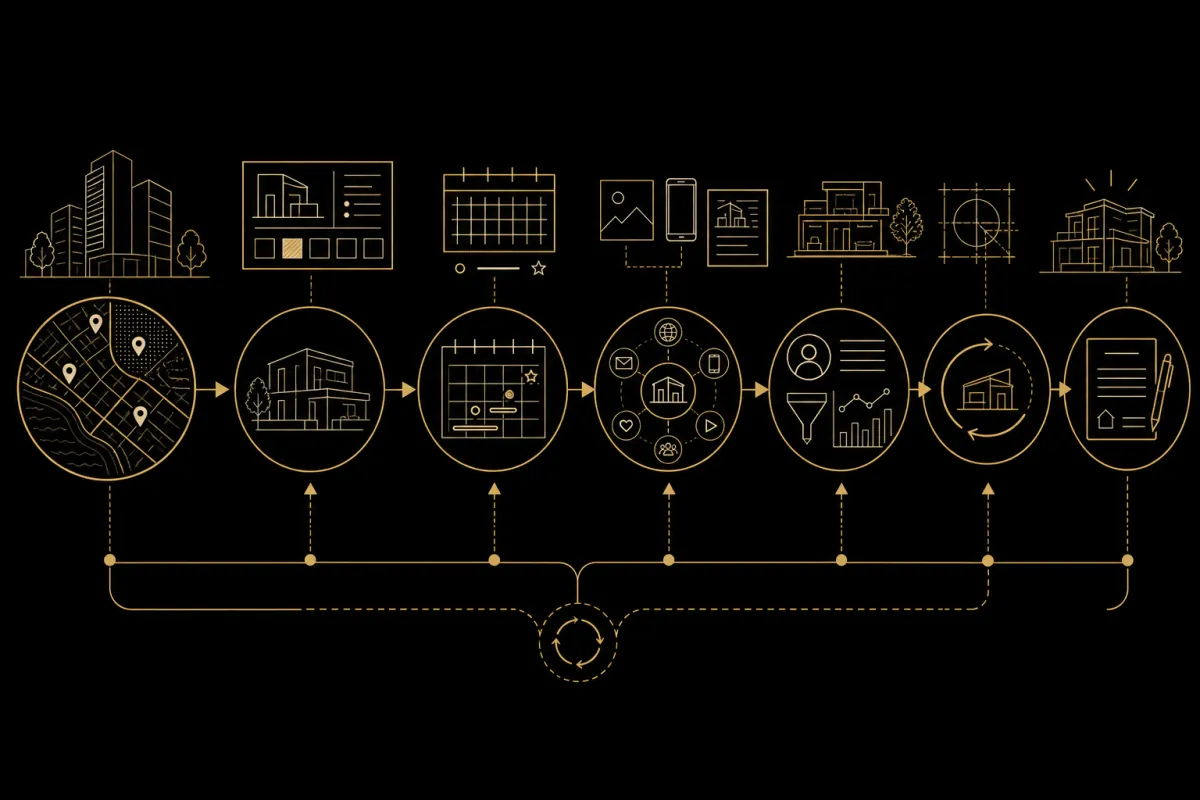
The playbook at a glance
Research, launch, measure, improve
Use the guide as a sequence rather than a menu of tactics. Each stage creates the inputs needed by the next one.
- Market map
- Launch plan
- Lead system
- Optimization loop
The Short Answer, Without Evasion
The clearest published Hebrew benchmark we found comes from one professional source. It cites a marketing budget of about 1% of the project's total sales value, with roughly 0.75% allocated to digital advertising. Professional guides abroad describe a similar range of 1% to 2% of sales value. This is also the starting point we use in our project marketing service before adjusting it to the project itself.
What does that mean in practice? This is an illustrative example only. A project with 60 units at an average price of ₪2.4 million has a total sales value of approximately ₪144 million. Using the published benchmark, the lifetime marketing framework would be roughly ₪1.4 million, most of it digital. This is not a proposal. It is a way to test whether a proposal you received is even in a plausible range.
Why does everyone still answer, "it depends"? Because project stage, audience, local competition, and the developer's brand genuinely move the figure in either direction. The rest of this page shows how, and which questions turn "it depends" into a budget.
Why Project-Marketing Firms Rarely Publish Price Lists
We examined the market in depth. Service pages for Israeli project-marketing firms give almost the same response: costs vary with project requirements, followed by a contact form. There are two fair reasons for that and one less comfortable reason.
The fair reasons are that projects genuinely differ in scale, stage, and audience, and that some pricing is a success fee negotiated around the developer's transaction structure. The less comfortable reason is that transparency invites comparison, and comparison puts pressure on price. The practical result for a developer or CMO is the same: it is difficult to build a budget before a sales call.
This page is intended to close that gap. We will not invent a price list, but we will unpack the cost structure in full as part of the transparency that runs through our entire real estate marketing system for developers, contractors, and real estate companies.
What the Budget Contains: Nine Components
The first mistake in reading proposals is to treat "marketing budget" as if it means media alone. Media is usually the largest component, but it is one of nine:
| Component | What it includes | One-time or ongoing |
|---|---|---|
| Research and strategy | Market and competitor analysis, pricing, audience, and message definition | One-time, before launch |
| Brand and creative | Name, visual language, sales brochure, and campaign concept | One-time, plus updates |
| Renderings, photography, and video | Exterior and interior renderings, project film, and construction-progress photography | One-time, refreshed by construction stage |
| Project website and landing pages | Project page, campaign landing pages, forms, and tracking | Build, plus maintenance |
| Media budget | Google, Meta, real estate portals, and outdoor signage | Ongoing, varies by stage |
| Campaign management | Platform management, optimization, and reporting | Ongoing |
| CRM and automation | Lead intake, routing, follow-up sequences, and call tracking | Build, plus ongoing operation |
| Sales operation | Salespeople, sales office, model apartment, and scripts | Ongoing |
| Public relations and content | Professional articles, media presence, and organic content | Ongoing |
When comparing proposals, the first question is which of these components are included, which are priced separately, and which remain your responsibility. Two proposals with the same bottom line can differ by hundreds of thousands of shekels in their true cost.
Four Fee Models, and What Each One Incentivizes
There is no universally "correct" model. There is a model suited to the stage, risk, and the party carrying it. What matters is understanding what each model encourages the provider to do.
Monthly retainer
A fixed payment for a defined team and scope. It supports thorough work over time, but without objectives and measurement it can also reward comfortable inactivity. It fits predictable, ongoing work such as campaign management, content, and continuous support.
Cost per lead, CPL
You pay for an immediate output, which makes budgeting straightforward. It rewards quantity rather than quality. Without a contractual definition of "lead" and an exclusivity requirement, you may pay for inquiries that never answer. It can work as a supplement, but is less suitable as the only model for an entire project.
Sales commission
A percentage of each deal. Its main advantage is that it rewards closings, but it can also encourage focus on easier apartments while difficult inventory is left for the end. It requires a clear definition of who generated the lead and who closed the deal.
Hybrid
A reduced retainer plus commission or performance bonus. It distributes risk between the parties and can align incentives, provided targets are based on signed deals rather than leads. It is a common model on larger projects.
Our rule is simple: the model is chosen around the project and explained in advance, including what it incentivizes us to do. You can read how Semerenko Group gets paid on a dedicated public page, with no form in the way.
The Figures That Have Been Published
To move beyond "it depends," we collected the public figures we found in the Israeli market, checked in July 2026:
| Benchmark | Figure | Published by |
|---|---|---|
| Total budget anchor | About 1% of sales value, including about 0.75% for digital | One Hebrew professional publication |
| International anchor | 1% to 2% of the project's total sales value | Professional guides abroad |
| Lead price in vendor lists | ₪90 to ₪150 per lead, plus VAT | Public lead-vendor price lists |
| Campaign lead cost | ₪300 to ₪800, and sometimes above ₪1,000 in expensive channels | Industry reports |
Source: industry publications and public price lists in Israel and abroad, checked July 2026. These are external figures, not our price list.
How can the range run from ₪90 to ₪800? Because a "lead" is not a uniform product. In vendor price lists, the inexpensive lead is often distributed to several competitors at once, sometimes as many as three, without deep qualification. An exclusive lead from a dedicated project campaign, tagged by budget, city, and purchase timing, costs more and is worth more.
The central conclusion of this page is simple: never compare price per lead alone. Compare cost per meeting and cost per deal. A ₪90 lead that does not answer is more expensive than a ₪500 lead that reaches a contract.
How to Derive a Budget for a Specific Project
Calculate total sales value
Multiply the number of units by the average price. This is the base against which every percentage is measured, and the first figure any serious provider will request.
Set a percentage anchor
Start with the published anchor and adjust it. A recognized developer brand and desirable location draw organic demand and reduce the percentage. A competitive market, narrow audience, or location requiring more explanation increases it.
Divide it by stage
Pre-launch and presale require investment before the first income: brand, renderings, website, and waitlist building, including work toward early-sales targets with the project lender. Launch is concentrated and intensive, construction is a long operating period, and the sales tail requires focused budget for specific apartments.
Divide it by audience
Move-up buyers, investors, and overseas buyers are not found in the same channels and do not cost the same to reach. English-speaking audiences, for example, require English marketing assets and longer follow-up cycles, but suitable projects face fewer competitors for their attention.
Keep a managed reserve
Part of the budget must remain flexible for creative tests, channels that outperform expectations, and course corrections after the first months of operation.
Three field examples show how the same percentage behaves differently. A boutique urban-renewal project in an established city center may rely heavily on neighborhood demand, effective signage, and a waitlist, with a relatively small media budget. A new neighborhood in the periphery may need to buy almost all its demand, increasing lead cost. A luxury project also targeting overseas buyers may pay more per inquiry but reach buyers with greater equity and face less competition. A serious proposal is therefore built only after project analysis, never before it.
How to Compare Proposals: A Checklist Before Signing
When three differently priced proposals are on the table, these questions put them on one comparable basis:
- Is the scope identical? Compare each of the nine components, not one bottom line against another.
- Is media spend separated from management fees, and what commission is charged on media?
- Who owns the advertising accounts, domain, website, and CRM on the day you part ways?
- What is the contractual definition of a "lead," and are leads exclusive to your project?
- Which reports will you receive, how often, and do they reach meeting and deal level by source?
- What are the exit terms, and what happens to commissions on deals that close after the engagement ends?
- Who responds to inquiries, and how quickly, including phone calls and WhatsApp?
The mistake: comparing price
The cheapest proposal is often the one that hides the most components. The most expensive proposal may be the least expensive when measured by cost per signed contract.
The mistake: commission without definitions
A sales commission without a definition of lead source and each party's contribution is a recipe for dispute during the exact months when the project needs to sell.
The mistake: cutting measurement
Call tracking, CRM, and source attribution can look like overhead. Without them, there is no way to know which ₪300 leads worked and which were wasted.
Why We Discuss Cost Only Together with Measurement
A budget without deal-level measurement is an annual guess involving millions of shekels. We do not merely recommend this approach. We operate it on our own platform every day, with every inquiry entering one system and full source attribution from click through to conversation.
Source: HubSpot CRM and Google Search Console for semerenkogroup.com, checked July 2026.
We explain how this measurement works on a client project, what enters the weekly report, and what we will publish as case studies only when real, verified material exists on our Results and Methodology page. It is also the basis of every proposal we submit: numbers that can be checked, not promises.
Request a Project-Specific Proposal
Send us the basics: location, number of units, average price, and project stage. We will respond with an initial budget framework and a pricing model whose incentives we explain precisely. If the project is not a fit for us, we will say so directly.