Branding, Content and Public Relations for Real Estate Projects
A project's brand is not decoration. It is a sales lever. A name, visual language and consistent message make it easier for buyers to understand why this development deserves attention and begin building trust before the first meeting. We build the brand to connect directly with advertising, leads and sales rather than stop at a polished presentation. It is one of the five service areas in our real estate marketing operation for developers, contractors and property companies.
- Search impressions
- 8.69M
- Clicks outside Israel
- 58%
- Attributed inquiries
- 350+
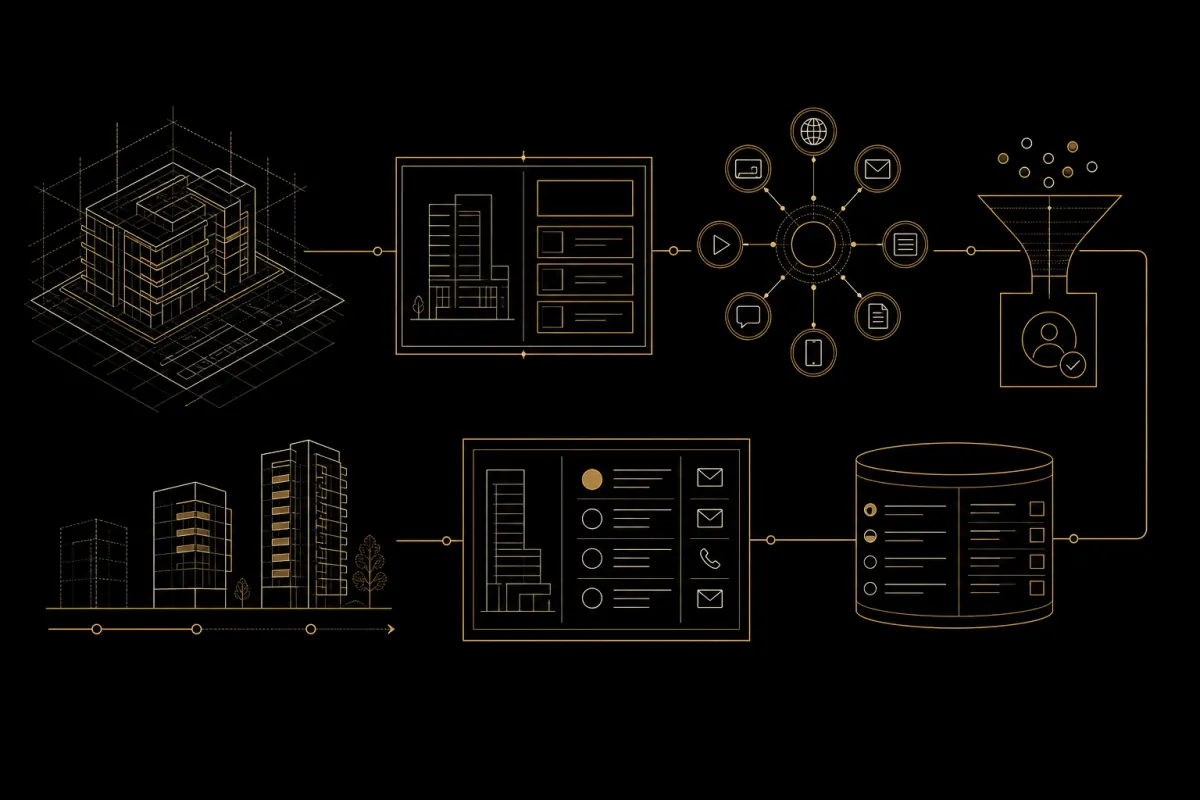
Project launch system
A launch system, not a collection of ads
Positioning, channel execution, lead qualification and sales follow-through must work as one operation. The visual makes those handoffs explicit.
- Positioning
- Channel plan
- Qualification
- Sales follow-through
Who this is for, and who it is not for
Project branding creates value when there is something meaningful to differentiate and enough time to build it. It is less relevant for the sales tail of a handful of units, where direct advertising and sales activity may deserve the investment. It becomes critical when a new development enters a crowded market in which every competitor looks and sounds the same.
This is a fit if
You are launching a new development, entering a competitive area or addressing an audience that requires a high level of trust, such as luxury buyers and foreign residents. You want the ad, the website and the sales representative to speak exactly the same language.
This is less likely to fit if
Only a few units remain and time is short, or you are looking for a pretty logo detached from sales. Branding that does not connect to the sales process is an expense, not an asset.
Brand strategy before creative
Before choosing a color or name, define five things: the audience, its problem, the project's promise, the evidence behind that promise and how the project differs from the one next door. Without those five decisions, every creative execution is an expensive guess. A sound strategy also gives each audience a distinct message. An investor, a young family and a move-up buyer should hear different reasons to consider the same development.
- Audience: who actually buys here, primary and secondary, for each unit type
- Problem and promise: what the project solves, expressed without slogans
- Evidence and differentiation: what supports the promise and distinguishes the development from nearby competition
- Personality and language: how the brand sounds, from the ad to the representative on the phone
One strategy can produce distinct messages for distinct audiences without breaking the core identity. The same project should sound different to an investor, a young family and a move-up buyer:
| Audience | What the message places at the center |
|---|---|
| Investor | Potential return, local rental demand and future liquidity |
| Young family | Entry price, community and nearby schools |
| Move-up buyer | A tangible upgrade in specification and space, with a payment schedule that accounts for selling the existing home |
| English-speaking buyer | A complete explanation in English, trust at a distance and proximity to the community they seek |
Project branding: from the name to the sales office
A project brand is a system of touchpoints that should feel like one continuous experience. A break between the ad and website, or between the website and sales office, damages trust at the critical moment. The system includes:
Name and verbal identity
A name that works on signage, in WhatsApp, in search and in English transliteration for overseas buyers. We cover this in greater depth in our guide to real estate project branding.
Visual identity
Logo, color, typography and architectural visualizations working as one language. Visualizations are part of the brand, not an appendix.
Marketing sales brochure
The marketing brochure is different from the statutory sale plan required under Israeli sale law. That distinction matters, and we explain it on the project-branding page.
Signage and sales office
The project fence, site signage and sales office continue the same language. The physical touchpoint closes the loop opened by digital marketing.
Creative that serves sales
Attractive creative that does not convert is wasted budget. Video, photography, drone footage, short-form clips, interviews, project tours and interior or exterior visualizations are selected according to what the audience needs to see to progress, not what might win a design award. In a foreign-resident campaign, for example, a video tour and footage of the surrounding area can be more useful than an impressive render because the buyer cannot simply arrive and inspect the site.
The operating rule is simple: every creative asset should answer a question the buyer is asking at that stage. A visualization answers what it will look like. A neighborhood video answers what it feels like to live here. An interview with the developer answers who is receiving the buyer's money. Creative that answers no question is decoration.
What you receive in practice
To keep branding from remaining an abstract idea, these are the deliverables built within this service area, each connected to a defined sales use:
Brand foundations
Name, logo, visual language and core message, with a concise brand guide that keeps every contributor consistent.
Sales assets
A marketing sales brochure, presentation and landing page that continue exactly the same language.
Campaign creative
Ads, video, photography and architectural visualizations adapted to each project stage and audience.
Physical presence
Project fencing, site signage and a sales office that close the loop for the buyer arriving to see the development.
Content and SEO for the developer and project
Content is more than a collection of articles. It is an asset that can bring in buyers who are already searching. The company site, project site, city and neighborhood content, buyer guides and English content for overseas audiences work together to support visibility on Google and in AI-assisted search. What matters in the age of AI Overviews is covered in our guide to real estate SEO and content marketing for developers.
We approach this from operating experience. Our English platform is a substantial Israeli real estate content resource, with market-data pages covering 203 cities and 1,371 neighborhoods, and it reaches an audience that many individual projects do not address.
Public relations and reputation
Reputation is critical currency in a high-value transaction, particularly for a skeptical Israeli investor or an overseas buyer purchasing remotely. Public relations can include professional articles in real estate publications, positioning executives as informed experts, responding to market news, presenting completed projects and managing reputation over time. Accuracy matters: sponsored content should be labeled as such, and we do not create fake reviews or articles that pretend to be independent journalism.
When a crisis does arrive, whether a delivery delay, market change or public complaint, transparency with buyers is usually stronger than silence. Trust is preserved during difficulty, not during routine.
Questions developers ask
Is branding a waste for a small project?
No, provided it connects to sales. In a small development, differentiation may matter even more because there is no enormous media budget to compensate for an unclear proposition. Focused branding helps each advertising shekel work harder.
What is the difference between the developer brand and the project brand?
The developer's brand builds trust over time and across projects. The project brand sells specific units now. They should speak to each other without colliding. We expand on that distinction on the real estate project-branding page.
Can the contribution of branding be measured?
Not as directly as a click, but its influence can be examined through conversion rates, inquiry quality and sales velocity when measurement connects source to deal. We do not promise a number. We measure movement.
Request a branding framework for your project
Send the basic project and audience details. We will return with an initial branding framework: what is required, what is better left out, and how the brand should connect with advertising and sales.