How to Market a New Real Estate Project in Israel
The complete playbook, step by step: what must be ready before launch, how the timeline runs from a quiet release to final-inventory sales, which channel serves each stage, and how to measure through to the deal rather than stopping at the lead.
The playbook at a glance
Research, launch, measure, improve
Use the guide as a sequence rather than a menu of tactics. Each stage creates the inputs needed by the next one.
- Market map
- Launch plan
- Lead system
- Optimization loop
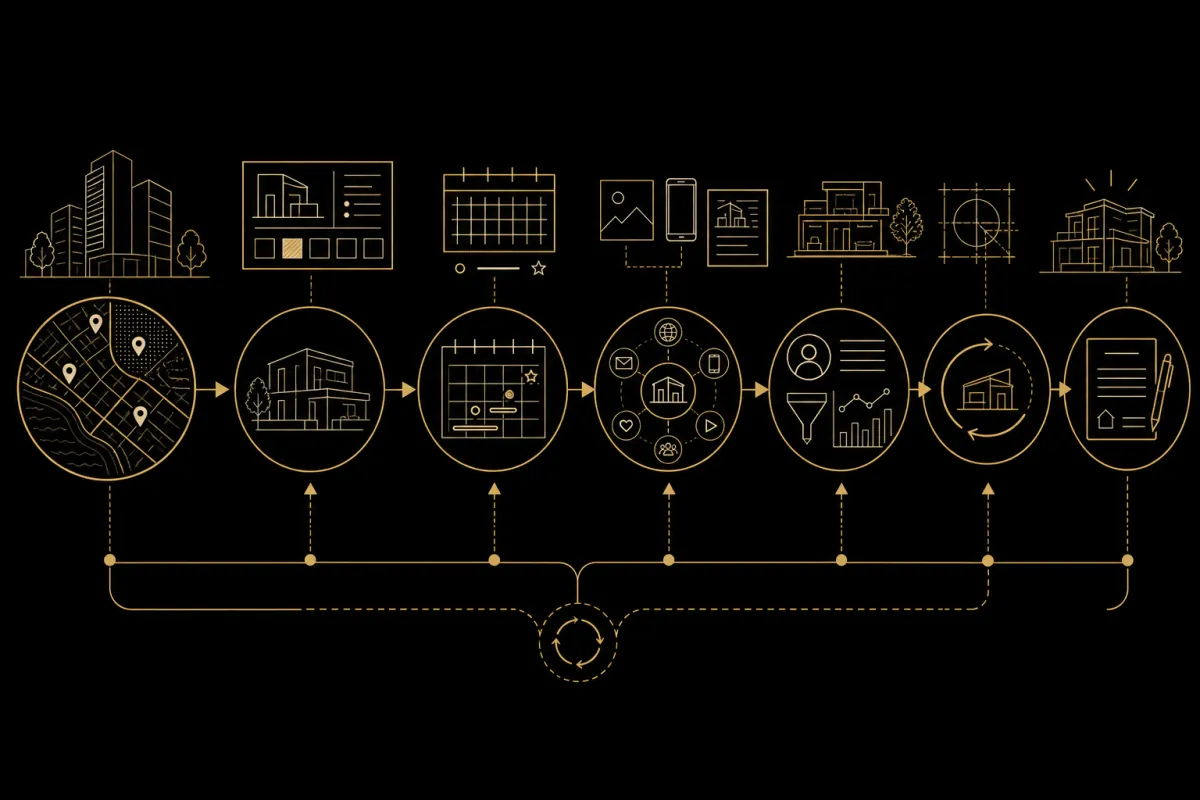
The Short Answer: An Order of Operations, Not a Channel List
A new real estate project is not marketed with "a campaign." It is marketed through a fixed order of operations: competitor and pricing research, audience and value-proposition definition, naming and messaging, preparation of marketing assets and the lead-management system, and only then paid media. The sales program itself runs through five stages: a quiet release to a close audience, presale, official launch, the construction period, and the sales tail. Each stage has its own objective, channel mix, and success measure. Developers who skip the preparation and run straight to media pay twice: once through higher lead costs and again through a sales team wasting hours on irrelevant inquiries.
This is the sequence we use in our project and new-build apartment marketing service, as part of our broader real estate marketing system for developers, contractors, and real estate companies. This page sets out the full playbook, including the parts you can implement without us.
Before the First Media Shekel: Competitors, Audience, and Value Proposition
A competitor map is not a list of projects in the city. It is an inventory picture: exactly what is selling around you, at what price, at what pace, and with which incentives. Most of the data can be gathered through two weeks of systematic work: visits to sales offices, monitoring competitor portals and advertisements, and conversations with active local brokers. The output should be one table updated every month, not a one-time presentation.
- Every active project in the competitive radius, including construction stage and expected occupancy date
- Price per square meter by unit mix: three, four, and five rooms, garden apartments, and penthouses
- Actual incentives: financing offers, payment schedules, closing discounts, and specification upgrades
- Estimated sales pace: how many units have sold since launch and what remains in inventory
- Each competitor's central message and the audience it addresses
This table drives the most important project-marketing decision: who the project is really for. Investors, families, move-up buyers, and sometimes overseas and English-speaking buyers do not respond to the same message or offer. The test for a value proposition is simple. If the sentence you wrote would also fit the competing project across the road, you do not yet have one. "Central location and a high construction standard" is not differentiation. It is an entry requirement.
The Name, Message, and Assets That Must Be Ready
A strong project name must survive four tests: a sign on a construction fence read from a moving car, a Google search field, a buyer's WhatsApp message to a friend, and a sensible English transliteration if the project may attract overseas buyers. The message follows the same logic: one core proposition, with audience-specific versions. Not three different messages competing with one another.
Before launch, you need renderings that respect the asking price, a sales brochure and specification that are easy to send through WhatsApp, a short video, signage and construction fencing, a sales office or model apartment timed to the right stage, and a call-tracked CRM that captures inquiries from day one. A marketing asset that arrives a month after the campaign begins is budget already burned.
Project website
It earns its place in a sales window of a year or more: room for content about the area, unit mix, and specification, a foundation for organic search, and infrastructure for multiple audiences and languages. The drawback is that building it properly takes time.
Landing page
It can go live within days, focuses on one message for one audience, and fits a paid presale campaign precisely. The drawback is that it does not accumulate organic value or answer the deeper questions of a serious buyer.
For a project with a sales window of two years or more, the answer is usually both, in this order: a landing page for presale, followed by a full website by the official launch.
The Timeline: Five Stages from Quiet Release to the Final Apartment
Dividing the work into stages is not semantics. It determines when money is spent, what it is spent on, and what success means at each point.
Quiet release, or pre-presale
Before any public advertising: a waitlist, past clients, employees, and close circles, often called Friends & Family. The purpose is validation, testing whether the pricing and offer create genuine purchase intent before media spend begins.
Presale
Early registration limited by quantity and time, a real incentive, and a sales event that closes the stage. Channels include email to the waitlist, a focused lead campaign, and proactive sales calls. This is where momentum for the whole project is established.
Official launch
A broad Google and Meta campaign, public relations, signage, and a launch event. The objective is to turn presale momentum into an established market presence and fill the sales office calendar.
Construction period
The longest and most neglected stage. The work is to maintain a consistent sales pace, publish construction-progress content, remarket to audiences that have already engaged, and optimize against CRM outcomes rather than platform metrics.
Sales tail and final inventory
The campaign changes direction. Broad project messaging gives way to unit-specific messages, defined closing offers, and precise work with a smaller, warmer audience. The final apartment is sold in a conversation, not by a banner.
| Stage | Primary objective | Main channels | Success measure |
|---|---|---|---|
| Quiet release | Validate price and offer | Waitlist, close circles, WhatsApp | Waitlist registrations and substantive conversations |
| Presale | First sales and momentum | Email, focused Meta lead campaign, phone | Registrations and deals at the event |
| Official launch | Full market presence | Google Ads, Meta, public relations, signage | Cost per meeting and sales pace |
| Construction period | Stable sales pace | Paid search, remarketing, organic content | Deals per month against target |
| Sales tail | Close final inventory | Warm audiences, unit-specific messages, phone | Cost per deal and time to close |
A Real Presale Versus a "Marketing Presale"
You cannot plan a presale in 2026 without acknowledging an uncomfortable fact: buyers have learned to be skeptical. Extensive Hebrew consumer content teaches them to distinguish a real presale from a "marketing presale," a promotional offer presented as an early sale. Publications of this kind cite roughly 15% to 20% of units, offered at a genuine discount, as a feature of a serious presale.
The conclusion for the developer is not to abandon presale, but to run a real one: a quota defined in advance, an incentive that stands up when a buyer checks it, an end date that is actually honored, and a price that genuinely rises after the stage. Artificial urgency may produce a handful of signatures, but it burns the trust needed at launch and over the two years that follow. A real presale also supports project financing because documented early sales are exactly what the project lender wants to see.
Google or Meta, Organic or Paid: How to Divide the Budget
Google Ads: existing demand
Captures people already searching for new apartments in the city, the project name, or the developer name. Purchase intent is high, lead cost is higher, and volume is limited by the number of local searches. Negative keywords, call tracking, and form tracking are mandatory.
Meta: demand creation
Reaches people who did not search for you through audiences by location and profile, remarketing, and the project's visual story. Lead cost is lower and quality varies, so qualification and rapid inquiry handling matter even more.
Paid media buys speed. Organic content accumulates value. In a sales window of 12 to 24 months, paid media carries the presale and launch, while organic content about the project, area, and purchase process begins to return value from the middle of the project onward, especially at company level from one project to the next. If your project may attract overseas and English-speaking buyers, English content is not a pleasant translation. It is a channel in its own right, and very few participants in the market operate it seriously.
The Marketing-Sales Handshake, with Measurement Through to the Deal
The best campaign cannot survive a sales team that calls a lead back two days later. Before launch, close the operating gap: an initial call script, consistent qualification questions covering budget, city, transaction type, purchase timing, and funding source, a response-time target for every new inquiry, and complete documentation in the CRM. A short weekly meeting between the media manager and sales manager is worth more than any report.
Measure a ladder, not one point: cost per lead, percentage of qualified leads, cost per meeting, registrations, and deals by source. Judging campaigns by lead cost alone almost always produces the wrong conclusion because the cheapest channel per lead is often the most expensive channel per deal. Our Results and Methodology page follows the same structure: what we measure, what we are prepared to show, and what we cannot show yet.
On budget, one published professional source in Hebrew cites approximately 1% of project sales value as the marketing budget. Treat it as a starting point for analysis, not a binding rule of thumb. We break down the budget components and fee models on How Much Does It Cost to Market a Real Estate Project in Israel?
Six Mistakes That Recur in Almost Every Project
Media before readiness
The campaign is live, but there is no CRM, no script, and nobody answering. The most expensive leads are the ones that were bought and never handled.
Artificial urgency
"Only three apartments left" in a project that has just launched. Buyers check, compare, and speak to one another. Burned trust does not come back.
Judging by lead cost alone
The channel producing the cheapest lead often produces the most expensive deal. Without measurement through to the meeting and deal, optimization is blind.
One message for every audience
An investor asks about returns, a family about schools and outdoor space, and a move-up buyer about the payment schedule. A message intended for everyone speaks to nobody.
Abandoning the construction period
After launch, the budget is cut and sales pace falls. During this long stage, progress content and remarketing sustain continuous sales at a lower cost.
Giving up on overseas buyers
In cities and neighborhoods with demand from English speakers and overseas buyers, one machine-translated page is not marketing. This audience requires its own channel, language, and guidance.
Go-Live Checklist
- A live competitor table covering prices, incentives, and sales pace, updated within the last month
- A primary and secondary audience, each with its own message and offer
- A project name tested on signage, in search, on WhatsApp, and in English transliteration
- Approved renderings, sales brochure, specification, and video ready to send
- A live landing page that loads quickly on mobile, with form, phone, and WhatsApp options
- A CRM that captures every channel, including call tracking and source attribution for each inquiry
- A written definition of a qualified lead: budget, city, purchase timing, financing capacity, and willingness to speak
- One call script and one set of qualification questions for the entire sales team
- A response-time target for new inquiries, including evening and weekend ownership
- A final, approved presale quota, incentive, and end date
- A media budget divided by stage, with decision points for reassessment
- A weekly report defined in advance: fields, source system, and accountable reader
Our Experience, in Numbers You Can Check
We did not assemble this playbook from presentations. We operate it every day on our own platform, one of Israel's largest English-language real estate content platforms, with market pages for 203 cities and 1,371 neighborhoods, and a complete lead operation. Forms, chat, phone, and WhatsApp all enter one pipeline with full source attribution for every inquiry.
Source: Google Search Console, GA4, and HubSpot CRM for semerenkogroup.com, checked July 2026.
What we do not have yet is public client case studies for project marketing, and we will not invent them. The figures above prove one precise point: we know how to build visibility, generate inquiries, and measure them through the funnel, including among English-speaking and overseas audiences that receive very little coverage in Hebrew project marketing.
Discuss Your Project Marketing with Us
Tell us about the project: city, number of units, stage, whether planning, permit, or construction, and your timeline. We will respond with an initial assessment and a proposed stage structure. If we are not the right fit, we will say so plainly.